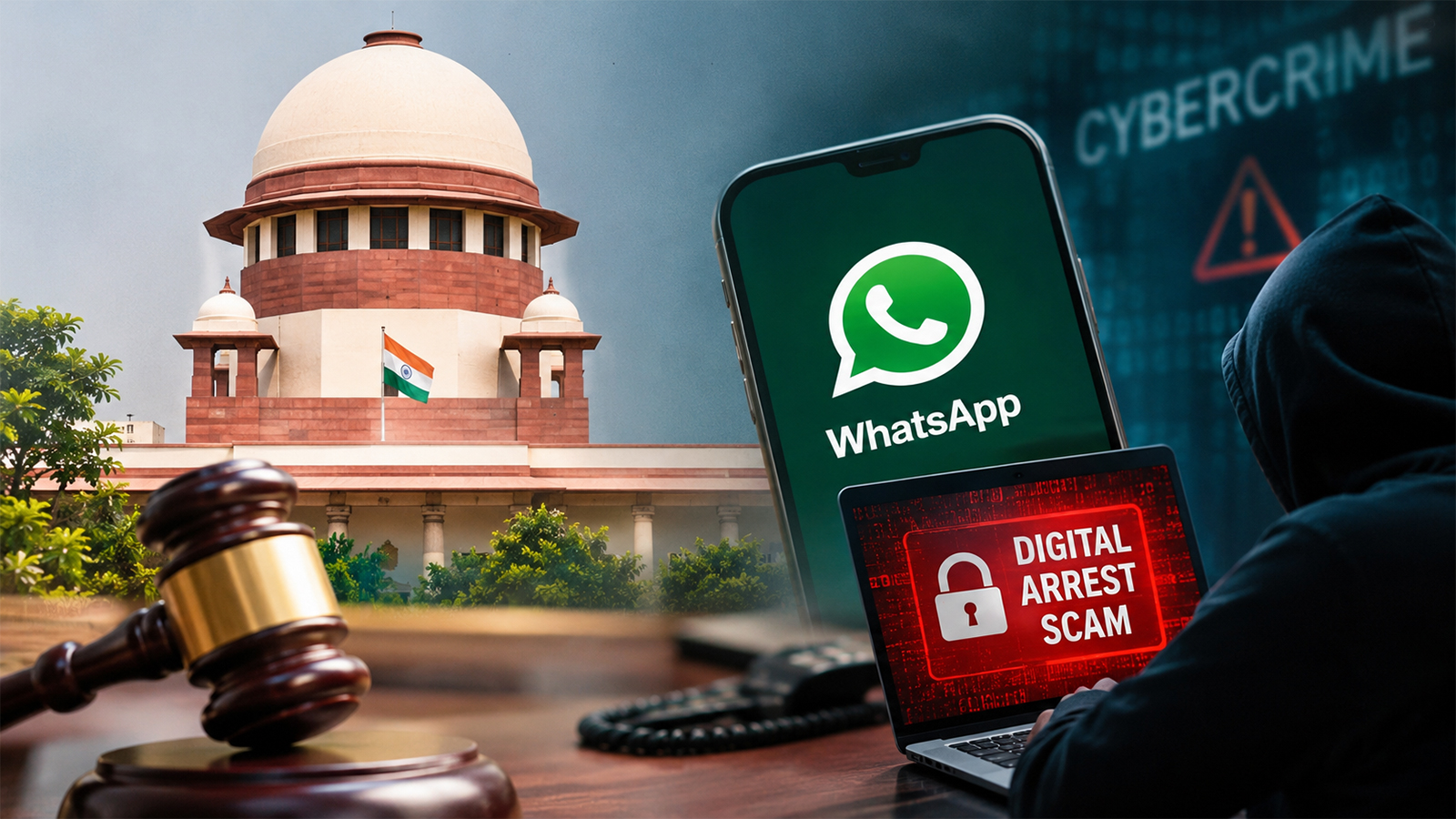
Supreme Court Directions on Digital Arrest Scams
The Supreme Court has directed WhatsApp and other online platforms to submit details of the measures they propose to prevent digital arrest scams and related cybercrimes. The court also called for greater accountability from banks and law enforcement agencies.
A bench comprising Chief Justice of India Surya Kant and Justices Joymalya Bagchi and V. Mohana issued the directions in a suo motu case concerning victims of digital arrest scams involving forged documents.
The order, issued following an October 29 hearing and reported on November 10, directed WhatsApp and other intermediaries to submit their proposed preventive measures to the Supreme Court and the Indian Cyber Crime Coordination Centre (I4C).
During the hearing, senior advocate Kapil Sibal, representing WhatsApp, informed the court that the platform had already taken action against approximately 9,400 accounts. He said the company was also developing software to identify suspicious accounts and warn users.
The Supreme Court also examined the responsibility of banks in preventing cyber fraud. It questioned why financial institutions were not intervening when customers attempted unusually large transactions that differed significantly from their regular banking activity.
The bench said the Reserve Bank of India’s proposed regulatory framework should include provisions requiring banks to compensate customers when fraud occurs because of a financial institution’s failure to exercise due diligence.
The court suggested preventive measures such as temporarily blocking suspicious transactions, alerting police and verifying unusual transfers. It emphasised that banks should use available customer transaction information to identify possible fraud.
The Supreme Court also directed the RBI to submit a list of authorised financial institutions. The bench said it would examine the proposed RBI Know Your Customer Amendment Directions, 2026, before the regulatory framework was finalised.
Meanwhile, the court directed law enforcement agencies across all states and Union Territories to submit reports on FIRs registered in digital arrest scam cases, along with details of investigations and measures to prevent similar offences.
The Directors General of Police were instructed to ensure compliance with these directions. The reports must also be shared with the Indian Cyber Crime Coordination Centre to support coordinated action against cybercriminals.
The Supreme Court observed that cyber fraud victims had reportedly lost around Rs 800 crore during the year despite a decline in the number of cybercrime cases. It stressed the need for preventive safeguards and institutional accountability.
The matter has been listed for further hearing on November 23, when the court is expected to review the responses from online platforms, the RBI and law enforcement agencies.
Film promotions on college campuses could soon face restrictions in Telangana. The state government is…
ఏపీ డిప్యూటీ సీఎం, జనసేన అధినేత పవన్ కళ్యాణ్, అన్న విడాకుల వార్త నేడు రెండు తెలుగు రాష్ట్రాలతో పాటుగా…
