BOTTOM LINE
A Fun, Action-Filled Holmes’ Origin
PLATFORM
PRIME VIDEO
RUNTIME
6 Hrs 27 Mins (8 Episodes)
What Is the Show About?
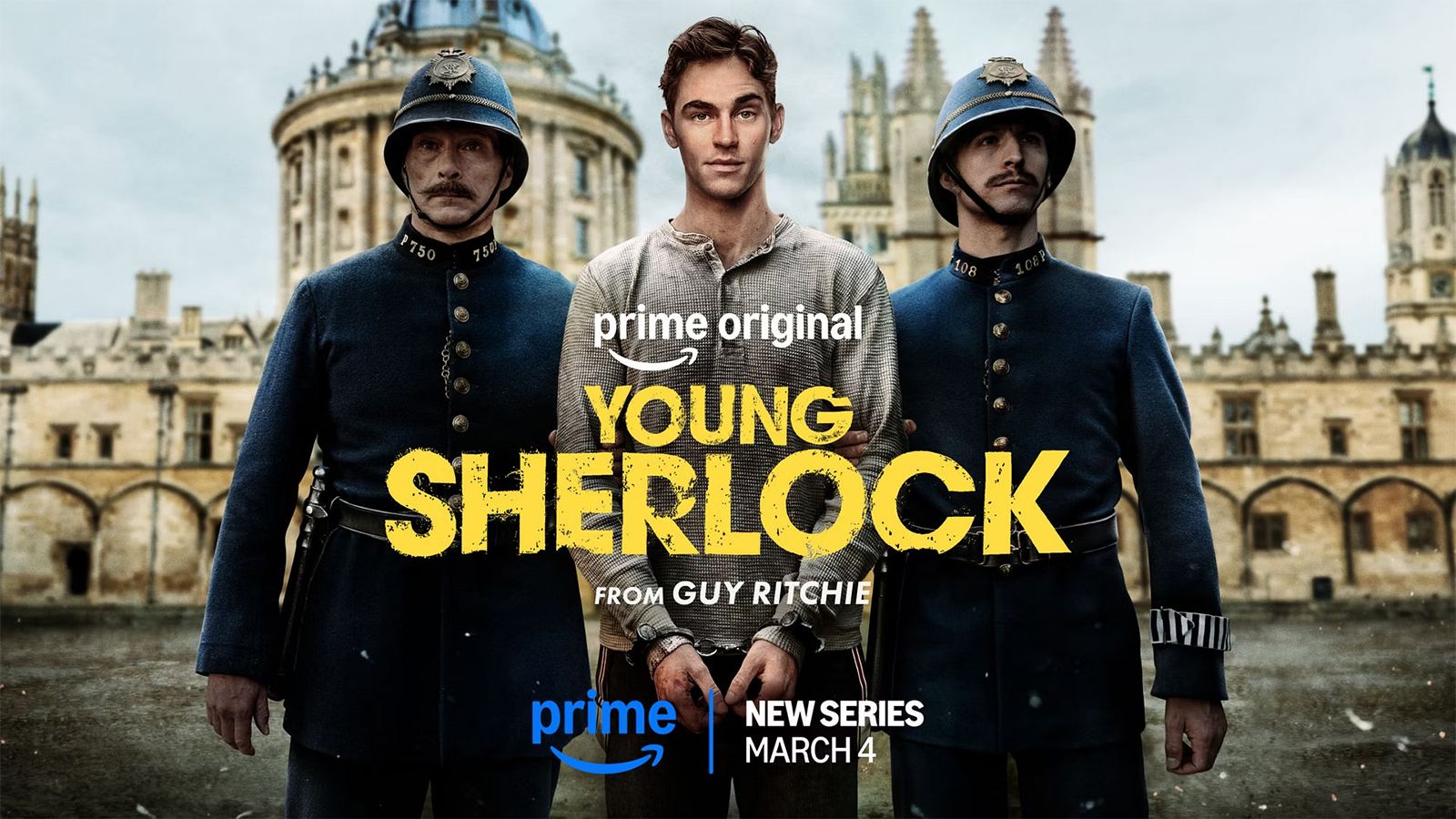
Directed by Guy Ritchie, the Prime Video series Young Sherlock serves as an action-packed origin story for the legendary detective. Set in the 1870s, the series follows a 19-year-old Sherlock Holmes (Hero Fiennes Tiffin) during his unpolished, rebellious years at Oxford University.
The plot kicks off when Sherlock is framed for a murder on campus. To clear his name and escape imprisonment, he must use his raw powers of deduction to navigate a sprawling web of secrets. In a surprising twist on the classic lore, Sherlock forms an unlikely alliance with a brilliant fellow student, James Moriarty, long before they became arch-enemies.
Together, they uncover a globe-trotting conspiracy involving an experimental weapon and deep-seated family trauma. Haunted by the mysterious death of his sister, Beatrice, Sherlock’s investigation takes him from the halls of Oxford to the streets of Paris and Constantinople, eventually forging him into the iconic investigator we know today.
Performances
Hero Fiennes Tiffin as the young 19-year-old Sherlock Holmes tries hard to be charming and likeable, but still an unpolished and raw version of the great detective, and succeeds most of the time. He brings much-needed freshness, intense energy, and curiosity to the role, which suits the show’s tone as it focuses on the legendary protagonist’s younger days.
Tiffin excels at portraying a Sherlock who still has so much to learn and improve and, sadly, doesn’t have all the answers in his sharp yet unpolished mind. But in some scenes, it is clearly visible that he is trying a bit too hard to stand out from the rest of the cast and make his own impact. What limits him is the lack of that “distinct eccentricity,” something that made the versions of Benedict Cumberbatch, Robert Downey Jr., and Jeremy Brett iconic.
Well, we can’t blame Tiffin for trying too hard, considering he has been haunted by criticisms regarding his work in the hollow, lame, and boring “After” movie series. Even Robert Pattinson had to do some serious grinding to completely shed his image as the flat-faced, always serious, cold Edward Cullen (Twilight). So, let’s hope the best for Tiffin’s future.
Tiffin leads the series, but it’s none other than Donal Finn (The Wheel of Time) who literally steals the show as Sherlock’s destined arch-nemesis, James Moriarty. He looks charming, cunning, and mischievous in his portrayal of Moriarty. And most importantly, his sweet-and-sour chemistry with Tiffin’s Sherlock, with enough dashes of sarcastic burns and genuine care for each other, is the heart of the show.
Analysis
Young Sherlock (created by Guy Ritchie) sometimes feels like a recycled spinoff from the same factory that produced Robert Downey Jr.’s Sherlock Holmes movies (2009 and 2011). But it shows great promise and has enough in its tank to stand on its own and excel in future seasons.
The first two episodes perfectly set up the overall ambience, the characters, and the Victorian setting with just enough playfulness and troublemaking. Although some viewers may feel the “low stakes” vibe in terms of storyline in these episodes, as we progress, the stakes and scale of the story gradually increase.
Along with this shift, we also witness the plot becoming more personal and troubling for Sherlock Holmes, adding more excitement and depth to the show.
The narrative is anchored by a dark secret: the supposed childhood drowning of Sherlock’s younger sister, Beatrice. This event shattered the family, sending their mother, Cordelia, to an asylum and causing Sherlock to be cast out by his father, Silas. As we go further, this plot point completely changes the show’s focus from a campus mystery to a high-stakes domestic tragedy.
Perhaps the most discussed narrative choice on social media is undoubtedly the friendship between Sherlock and Moriarty. The chemistry between Tiffin and Finn is gold. They operate as a “Professor X and Magneto”-style duo. Moriarty is a charming but sharp scholarship student who resents the elite, while Sherlock is a highly observant, prosperous, but troublesome boy trying to find his way.
Since Guy Ritchie is directing, the first couple of episodes appear fast and loud (a classic Ritchie move). Instead of giving each episode a different case or mystery to solve, they make it feel like one long eight-hour movie. This keeps the energy high and makes you want to hit the next episode immediately.
But the series drags a bit in the middle. The show starts at Oxford but then jumps all over the world, and that switch can feel a little messy. Because the story gets so big, the main mystery sometimes feels stretched a bit too thin before the big finale.
Ritchie brings his usual high-energy style of direction, including his trademark fast cuts, slow-motion bare-knuckle brawls, and a camera that never stays still. This will often remind you of the RDJ Sherlock Holmes movies.
One of the biggest positives emerging from his direction is the “Analog Mind Palace” sequences. Instead of using tons of CGI like the BBC version, they use old-school camera tricks (like spinning effects and smooth transitions) to show how Sherlock’s brain works. It feels more real.
By the time the finale arrives, it becomes clear that their friendship was used to plant the seeds of their future rivalry. It wouldn’t be surprising if we see Sherlock and Moriarty finding themselves on opposite sides of the fence in the next season, and that would be really exciting to watch.
In addition, the story loses its “detective” identity in the final episodes, pivoting too hard into a globe-trotting action thriller that feels more like Mission: Impossible than Sherlock Holmes.
The series also excels in terms of dialogue. The top-notch banter between Sherlock and Moriarty is easily the best part of the script. It’s sharp, funny, and totally lacks that boring, stiff “Victorian gentleman” vibe. The banter between these two saves the show from becoming tasteless on numerous occasions. These characters keep us hooked to our screens and keep our energy high.
Overall, Guy Ritchie’s Young Sherlock is a fun and bingeable ride. Hero Fiennes Tiffin delivers a raw, rebellious Sherlock, though Donal Finn’s Moriarty truly steals the show through their “Magneto and Professor X”-style chemistry.
While the mid-season pacing drags and the “commoner” take on Mycroft falls flat, the series excels with its “Analog” Mind Palace sequences and pricey, globe-trotting scale. It’s a stylish origin story that successfully humanises the detective through deep-seated family tragedy.
Performances by Others Actors
Veteran actors provide much-needed gravitas to Young Sherlock. Veteran Colin Firth plays the pompous, arrogant, and self-centred Sir Bucephalus Hodge with ease, while Natascha McElhone (Cordelia Holmes) bestows a warm, glowing portrayal of Sherlock’s troubled mother and often steers the emotional core of the protagonist along with the entire Holmes family.
Zine Tseng is a surprise hit, as we see plenty of layers beneath her character of Princess Gulun Shou’an. In addition to her deep-seated vulnerabilities and emotional complexities, she also brings her martial arts skills and cunningness to the table, thus serving as a well-suited intellectual equal to the lead duo.
The weakest link in the show’s cast is undoubtedly Mycroft Holmes, Sherlock’s brother, played by Max Irons. We are not taking anything away from Irons’ work in the show, but his portrayal of a “commoner” and surprisingly unambitious Mycroft, rather than a genius-level tactician (as per the novels), doesn’t land that well. We see some hints of his genius, but most of the time, we see him either clueless or lashing out at Sherlock’s mischievousness.
Joseph Fiennes’ take on Silas Holmes (Sherlock’s father) looks grounded and weary. His natural, tense chemistry with his real-life nephew, Hero Fiennes Tiffin, adds emotional depth to the family’s tragic backstory. But he needed more screentime.
Music and Other Departments?
The soundtrack is a total mashup of different styles that somehow works. You get fast-paced Irish folk music during the brawls mixed with tracks from bands like Black Sabbath and Radiohead. The theme song by Kasabian is a total “banger” and really fits the vibe of a rebellious 19-year-old Sherlock. However, some of these iconic tracks don’t work that well, and they end up giving the vibe that the show is trying really hard to be cool, edgy, and stylish.
Instead of using floating text and tons of CGI like the Benedict Cumberbatch version, this show uses clever camera tricks. To show how Sherlock’s brain works, they use spinning effects and smooth transitions where he and Moriarty literally walk through a “frozen” crime scene. It looks way more grounded and stylish.
It’s quite clear that Amazon has invested plenty of money into Young Sherlock’s production. The makers filmed in real-world locations like Oxford, Bristol, and Spain (Cádiz and Seville), which makes the whole thing feel like a huge, world-travelling adventure.
The editing has that classic Guy Ritchie vibe; it’s full of fast cuts, shaky camera shots, and slow-motion fight scenes that keep everything feeling energetic and bubbly. The series also excels in terms of costume design.
Highlights?
Moriarty & Sherlock Dynamic
Donal Finn’s Performance
The “Analog” Mind Palace sequences
Supporting Cast
Production Value
Sharp Dialogue
Drawbacks?
Lack of “Sherlockian” Eccentricity
Mid-Season Pacing
The “Mycroft” Issue
Underused Talent (Joseph Fiennes)
Mid-season tonal shift
Did I Enjoy It?
Yes. Loved the high-energy “bromance” between Sherlock and Moriarty and those clever, old-school “Analog Mind Palace” sequences. While the middle episodes dragged a bit and the shift into an action thriller vibe was a little jarring, the sharp banter and stylish Ritchie vibes keep us hooked.
Will You Recommend It?
Definitely recommend it if you’re looking for a fun, action-packed, and fast-paced series rather than a traditional, slow-burning detective mystery. It’s perfect for fans of the RDJ movies who want a fresh, rebellious take on the characters, though Sherlock purists might find the changes to Mycroft and the modern music a bit much.
Young Sherlock Series Reviewed by M9 News