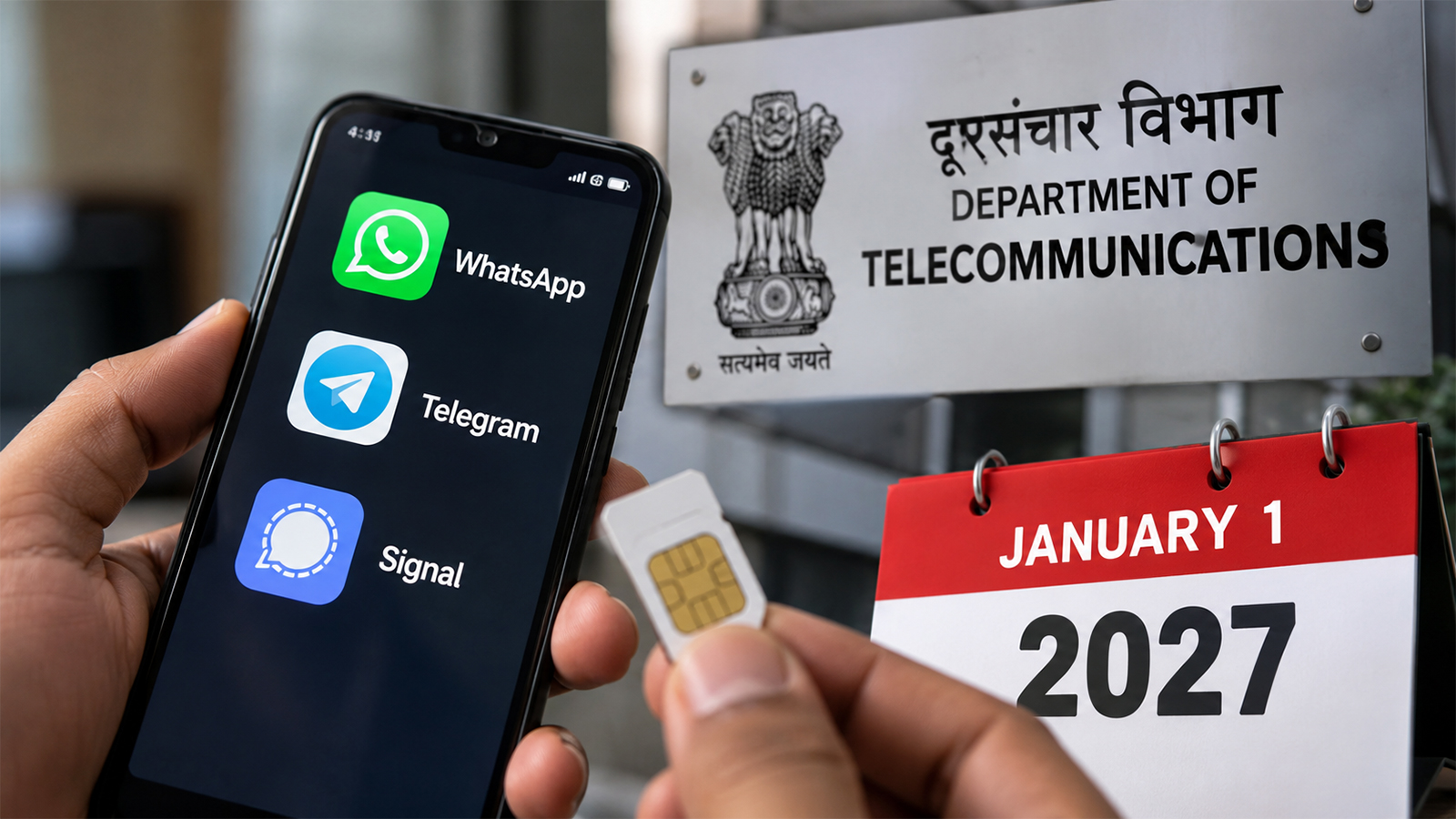
WhatsApp SIM Rules Begin January 1, 2027
WhatsApp, Telegram and other messaging app users in India could face new restrictions from January 1, 2027, as the Department of Telecommunications (DoT) prepares to enforce SIM-binding requirements. Under the rules, messaging accounts must remain linked to the active SIM cards used for registration.
The DoT has directed communication platforms to complete the necessary changes by December 31, 2026. The move aims to prevent cybercriminals from misusing Indian mobile numbers to operate messaging accounts without the registered SIM cards.
Under SIM binding, users must keep the SIM associated with their registered mobile number active and present in the device where the messaging application is installed. Removing or deactivating the SIM could interrupt access to the account once the requirements are enforced.
Currently, messaging apps generally verify a mobile number during initial registration. However, users can often continue accessing their accounts even after removing the SIM or transferring it to another device. The government wants to address this security gap.
The requirements cover popular services such as WhatsApp, Telegram and Signal, along with several other communication platforms. However, the precise implementation and compliance status may differ between applications.
Users who operate WhatsApp or Telegram on phones without the registered SIM could be particularly affected. Those using one SIM in a primary phone while accessing the account on another handset may also face restrictions.
For regular users who keep their registered SIM active in the same smartphone, the changes may have little immediate impact. However, accessing an account through Wi-Fi alone may not be sufficient if the required SIM is absent.
The government initially wanted these rules implemented by March 2026. However, following requests from technology companies over technical challenges, the compliance deadline was extended to December 31, 2026.
The DoT has also relaxed its earlier proposal requiring web and desktop messaging sessions to log out automatically every six hours. Instead, the government has adopted a risk-based logout system, under which sessions may be terminated when suspicious activity is detected.
The main objective is to prevent scams involving fake identities, digital arrests, financial fraud and impersonation. Authorities believe that linking messaging accounts continuously to registered SIM cards can improve accountability and make misuse more difficult.
With the compliance deadline approaching, messaging platforms are expected to complete the necessary technical changes. However, the exact user experience, including how linked devices and secondary phones will function, will depend on implementation by individual platforms.
The Andhra Pradesh State Election Commission (SEC) has rescheduled municipal elections in 99 urban local…
Athulya Ravi steps into this gallery with a glow that feels rich, modern and effortlessly…
