BOTTOM LINE
Ambitious But Indulgent Historical Drama
PLATFORM
Sonyliv
RUNTIME
8Hrs 15Mins.
What Is the Film About?
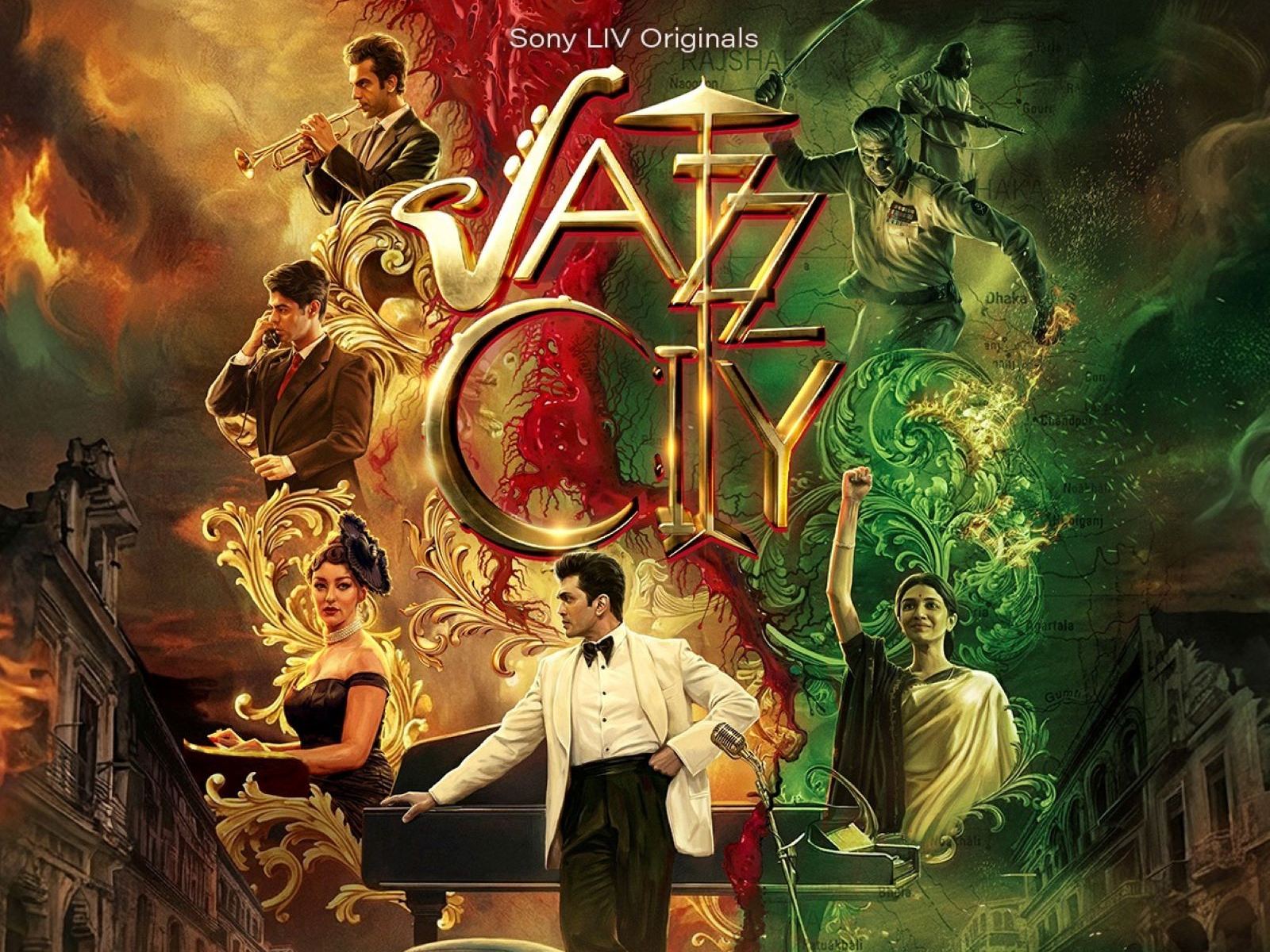
In 1969 Calcutta, jazz club owner Jimmy struggles to keep his business afloat as political violence grips the city. When civil war erupts in neighbouring East Pakistan, Jimmy’s club is transformed into a clandestine hub for the resistance. Forced from the sidelines to the front lines, he begins smuggling refugees and confronting military atrocities head-on. To save his friends and expose the truth, Jimmy risks everything.
Performances
Arifin Shuvoo, as the face of the club, appears suave and stylish, capturing the boyish charm in 1970s Calcutta, yet his performance ultimately lacks the gravitas required to navigate the character’s later transformation with sufficient depth. Sauraseni Maitra is a picture of elegance, portraying a reformist woman extending aid in a time of crisis, though the role remains somewhat underwritten, offering her little room for development.
Among the supporting cast, Shantanu Ghatak and Alexandra Taylor register a stronger impact: while Ghatak mirrors Sinha’s cheeky, streetsmart ways with impressive precision, Taylor effectively conveys Pamela’s yearning for companionship and her desire to belong to a conventional family.
In contrast, Alokika Dey feels miscast as Indira Gandhi, delivering a caricaturish performance, whereas Shataf Figar serves as the quintessential antagonist, appearing as the typical villain one is meant to loathe.
Analysis
Many historical sagas capturing the toil for freedom tend to frame them as the journey of a man who changed the face of a nation. The focus usually settles on an icon and the hysteria surrounding them, largely relegating the efforts of the average citizen to the sidelines, as if their perspective were not a story worth telling. Jazz City, a semi-fictionalised show on the Bangladesh Liberation War, breaks free from this clutter.
The club after which the show is named serves as the epicentre of the struggle, exploring the many dimensions of the conflicts among neighbouring nations that led to the formation of Bangladesh. The nine-hour runtime and expansive canvas give creator Soumik Sen a vast scope to unearth the many layers of the Bengali resistance, while ensuring the stakes remain deeply personal.
Jimmy Roy, the club owner, represents the politically reluctant, partly selfish, and privileged common man, who is witness to the tension leading to the war and evolves through a period of turbulence. The show can also be viewed as his coming-of-age story, from his beginnings as a youngster who looks only to himself and the club to his eventual transformation into a rebel with a cause.
The jazz musical backdrop adds texture to this tale of resistance set in a club that houses the privileged class, government officials, refugees, rebels, war journalists, musicians, and spies under one roof, as a rare site where multiple perspectives could co-exist. The club is precisely the site where the ‘personal’ and the ‘political’ collide, like an inanimate witness that has seen it all.
The show unfolds across West Pakistan, East Pakistan (now Bangladesh), and Calcutta, offering a sense of the politics surrounding the Bengali language, religion, and the electoral drama preceding 1971. The politics of the series, in a nutshell, can be boiled down to the scene where a civilian in West Pakistan is asked by a cop to choose between his Bengali and Muslim identity, while the latter wants ‘both.’
As expected, in times when relationships between neighbouring nations have taken an anxious turn, the story takes potshots at the imposition of Urdu, representing West Pakistan’s political stance through a bitter officer who seeks vengeance. Yet, one cannot ignore the show’s humanitarian undercurrent, of not losing compassion or the awareness of who we are, even when war stares at you, and an opponent directs a pistol towards you.
Despite the strengths of its expansive narrative, the storytelling gradually loses its emotional grip as the stakes rise. The treatment is leisured and yet fluid, while the pivotal characters and their interpersonal relationships are laid bare: the playful Jimmy, his old flame Sheela, the shrewd intelligence officer Sinha, the newly appointed club manager Rambahadur, and the resident jazz singer Pamela.
The episode where Jimmy journeys into East Pakistan to find a medico to treat cholera is a reflection of the show’s compelling cultural detailing. However, as the narrative sheds its quirky, childlike sheen to confront the ugliness of wartime politics, the espionage drama and the refugee crisis in Calcutta, the events begin to lose their impact. The writing grows increasingly verbose, preachy, stuffing one event after the other, appearing far too conscious of its own historicity.
Jimmy Roy’s gradual transformation, the heart of the tale, appears forced. While the presence of a Pakistani journalist in the shootout and his subsequent report on Jimmy’s heroics drive the director’s message, the execution relies too heavily on talk: everything is often stated rather than shown.
Jazz City, in terms of its span, technical finesse, and the scale at which it is mounted, is sure to inspire a new wave of enthusiasm in the Bengali OTT space, even if its initial vigour is notably amiss in the latter set of episodes.
Music and Other Departments?
Arka Mukherjee, Diptarka Bose, and Soumik Sen collaborate to deliver an eclectic soundtrack that embodies the spirit of the Bengali music scene in the late 1960s and early 1970s, creating a compelling fusion of jazz and Rabindra Sangeet. Cinematographer Pratik Parmar’s vivid recreation of these turbulent times is further elevated by the stunning production design and meticulous costume work. While the writing is certainly ambitious, one cannot help but feel that its essence is lost in translation during the final episodes.
Highlights?
Compelling premise
Attention to detail with cinematography, production design, music and costumes
The initial 3-4 episodes lay a neat foundation
Drawbacks?
Lacks a strong emotional impact
Over-simplified treatment in places
The long-drawn narrative style
Did I Enjoy It?
Yes, even if it’s far from perfect
Will You Recommend It?
Give it your time and stay patient for the payoffs
Jazz City Sonyliv Series Reviewed by M9 News