
BOTTOM LINE
Saif Shines Bright In a Mid-Thriller
PLATFORM
Netflix
RUNTIME
110 Minutes
What Is the Show About?
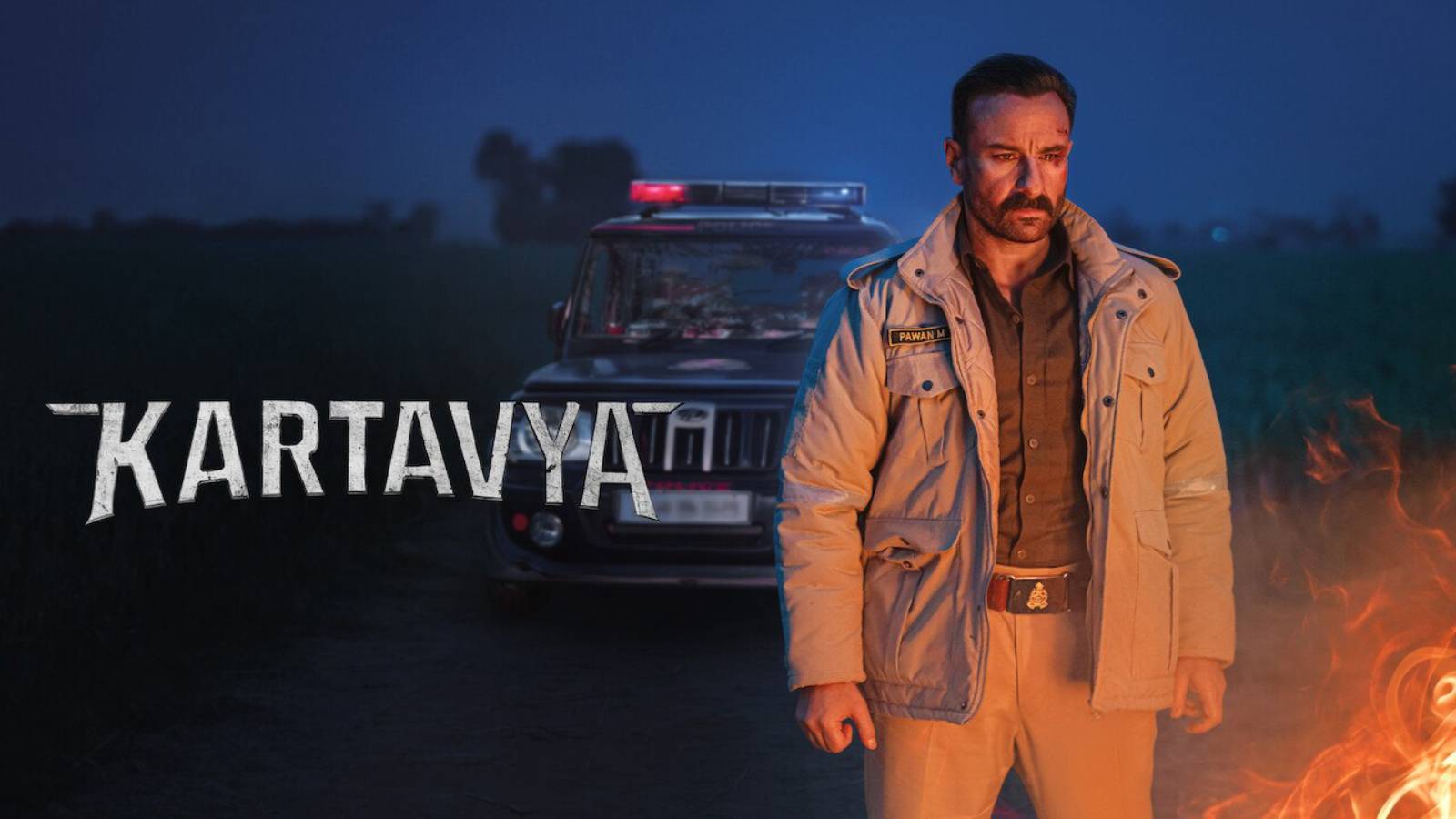
Pawan has just turned 40, and is asked to lead a group of officers to guard a journo Reema, from trouble. She’s gunned down by a 16-year-old, who has alleged links to a self-proclaimed godman, Anand Shri. Back home, Pawan’s brother has eloped with his lady love, leading to a crisis in the village. When none around him proves to be worthy of his trust, Pawan banks on his conscience to fulfil his duty.
Performances
Saif Ali Khan is absolutely terrific as the middle-aged man trying to make sense of the world around him. Caught between a cut-throat job and a toxic family, he becomes an emotionally vulnerable individual you cannot help but empathise with. Rasika Dugal offers a calming presence, though one wishes she had more to do in a story so heavily dominated by men.
The supporting cast is solid, comprising heavyweights like Sanjay Mishra, Zakir Hussain, and Manish Chaudhari. Mishra and Hussain make the most of their moments, though Chaudhari’s presence feels marginal. Saurabh Dwivedi looks the part as Anand Shri, aided by flashy costumes, but the characterisation lacks the necessary firepower.
Analysis
Kartavya may be a crime thriller set in the fictitious Haryanvi village Jhamili, but it is a story populated with metaphors as much as it is packed with rage-filled men. Jhamili is visualised as a muddy jungle (it could be a city or a country too) that has moved far beyond the ideas of right and wrong or law and order. The moral fabric of the region is so rotten that anything obstructing blind faith is conveniently eliminated.
The policeman Pawan (Saif) finds solace in the Mahabharata while confronting moral dilemmas at work and home. The locals have surrendered themselves to a leader supremo, Anand Shri, who milks their insecurities to the hilt. The region operates in binaries where mob justice prevails. Pawan acts as the conscience-keeper in a story where the personal and the political collide dangerously.
Director Pulkit (who helmed Rajkummar Rao’s Maalik), with Kartavya, delivers a rustic tale that marks Saif’s return to the heartlands years after Omkara. The film alternates between a cop’s pursuit of a teenage gunman and his quest to keep a rebellious brother safe from the prying eyes of a village baying for his blood. The brutality of the events transforms Pawan into a man he himself can’t recognise.
The narrative works better as a character study of Pawan and the hyper-masculine men around him than as a plot. The heart of the story lies in his conversations with an ally-like senior constable, a teenager drowned in crime, a superior hellbent on protecting the powerful, and a father placing honour above family. Pawan is constantly at war with himself.
‘Dharam karte hai..karm chuttha hai..karm karte hai dharm chuttha hai.. kartavya tak toh baat hi nahi pahunchti saali,’ Pawan says once. It’s through these dilemmas that Kartavya asks pointed, prickly questions. Where do you draw the line with blind acceptance? How do you raise a child right in a near-dystopian land?
While Kartavya effectively portrays the erosion of humanity within its arid setting, the film becomes so caught up in atmospherics and the socio-cultural details that it lacks a clear focus. It tries to tackle poignant, burning issues but fails to wrap them in the right vessel. Everything that it intends to convey is too literal, and there isn’t adequate complexity in the characters around Pawan (at least, a good villain perhaps?) to keep you glued.
Even with the way it ends, Pawan himself remains unsure if his choices were right at all. There’s no convenient closure (which is fine in principle), but it doesn’t affect you deeply either. Kartavya is a film that sparkles intermittently. It possesses hard-hitting ideas and a superb Saif Ali Khan, yet leaves you only half-satisfied.
Music and Other Departments?
The technical team succeeds in crafting a raw, rustic vibe through the music, visuals, and staging. The craft drives its ideas. The background score allows tension to build without filling up the silences, which is a significant victory.
Anuj Rakesh Dhawan’s cinematography and the action sequences (composed by Vikram Dahiya and Anthony Stone) are major highlights. While the narrative is compact, the screenwriting could have been more holistic. The dialogues, however, possess a likeable, old-world flavour.
Highlights?
Saif’s performance
Raw intensity, action
Gripping in parts
Drawbacks?
Lacks a tight screenplay
Says more than it shows
Vague ending
Did I Enjoy It?
Only in parts, mostly for Saif.
Will You Recommend It?
It is fairly watchable, but be prepared to be underwhelmed. Works best for the raw staging, sharp dialogues, and lead performance.
Kartavya Web Series Reviewed M9 News