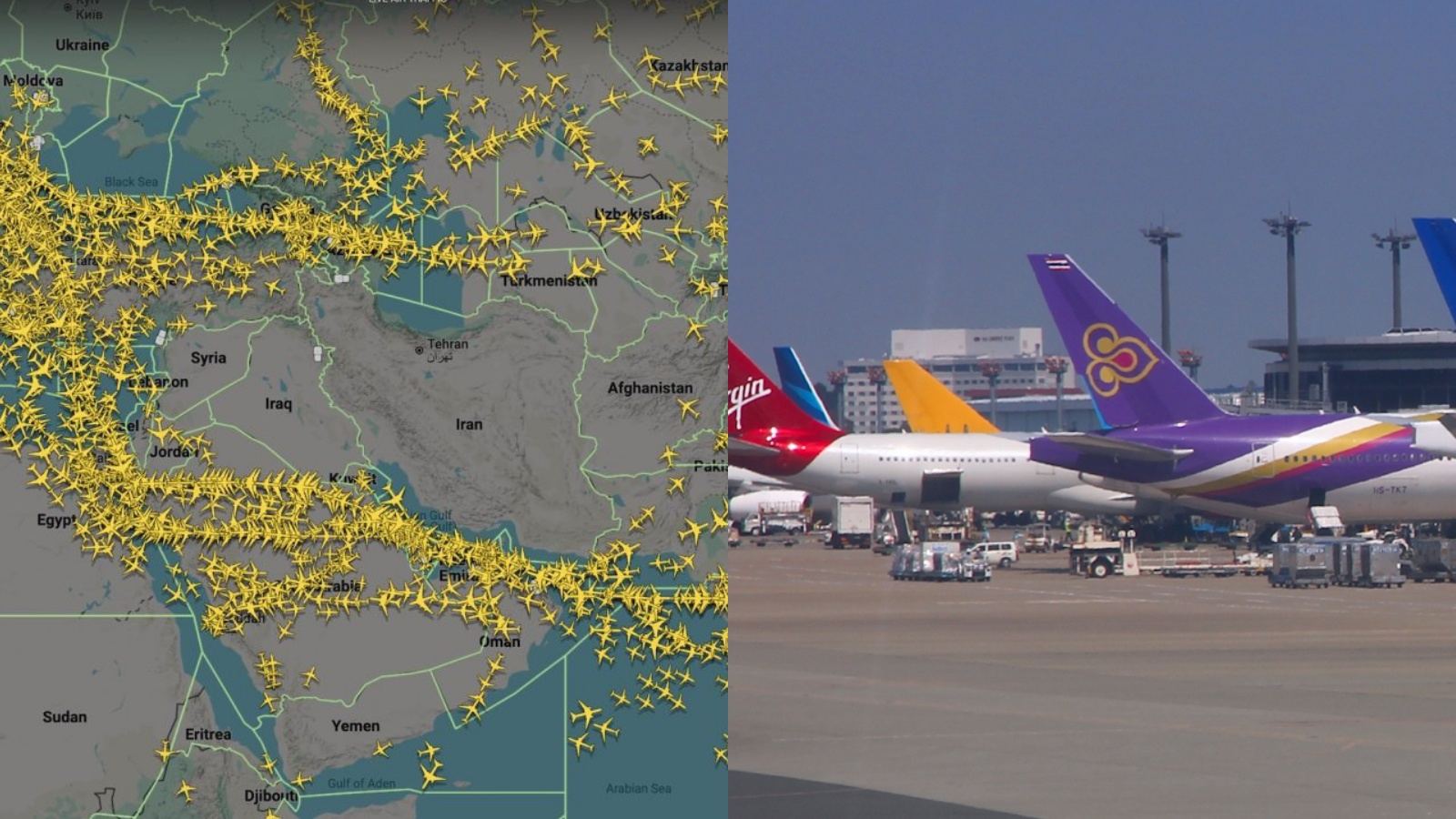
Airlines around the world are being forced to rethink their flight routes as airspace restrictions in parts of the Middle East disrupt global aviation. Political tensions and security concerns have closed several important air corridors used for international travel.
These routes normally connect Europe, Asia and Australia through the most direct paths. Because some of these corridors are now restricted, airlines are rerouting aircraft through longer routes. This has increased travel distance and created operational challenges for many carriers.
The Middle East has traditionally served as a key crossroads for global air travel. Flights between continents often pass through airspace above countries such as Iran and Iraq. These routes usually offer the most efficient path for long distance journeys.
When such airspace becomes restricted, airlines must quickly shift to alternative corridors. These detours can add hundreds of kilometres to a single journey. As a result, flight duration and operational planning become more complicated.
Rerouting aircraft is not a simple process for airlines. Dispatch teams must evaluate aircraft range, fuel requirements, weather conditions and available airspace before approving a new route. Each change requires careful coordination with air traffic authorities.
Longer routes also increase fuel consumption for airlines. Higher fuel usage leads to rising operational costs. In some cases, airlines may need to adjust passenger loads or schedule refuelling stops to complete the journey safely.
The disruptions have also created congestion in the remaining open corridors. Air traffic controllers are now managing more aircraft within limited routes. Aviation experts describe this situation as a funnel effect.
Because of this congestion, some flights must wait longer for clearance to enter busy airspace. These delays can slow down the entire aviation network. Even small disruptions can quickly affect multiple flights.
Passengers have already started experiencing the impact of these changes. Flights that previously took around ten hours may now take twelve hours or more. Travel times depend heavily on the rerouted paths chosen by airlines.
Late arrivals can also cause further scheduling problems. Aircraft that land behind schedule may delay the next planned departures. This creates a chain reaction across airline operations.
Airlines are continuously adjusting flight plans in response to the evolving situation. The disruptions highlight how sensitive the global aviation network can be. When major air corridors close suddenly, the effects spread quickly across international travel.