BOTTOM LINE
Watchable, Lacks Enough Punch
PLATFORM
Amazon Prime Video
RUNTIME
2Hrs.
What Is the Film About?
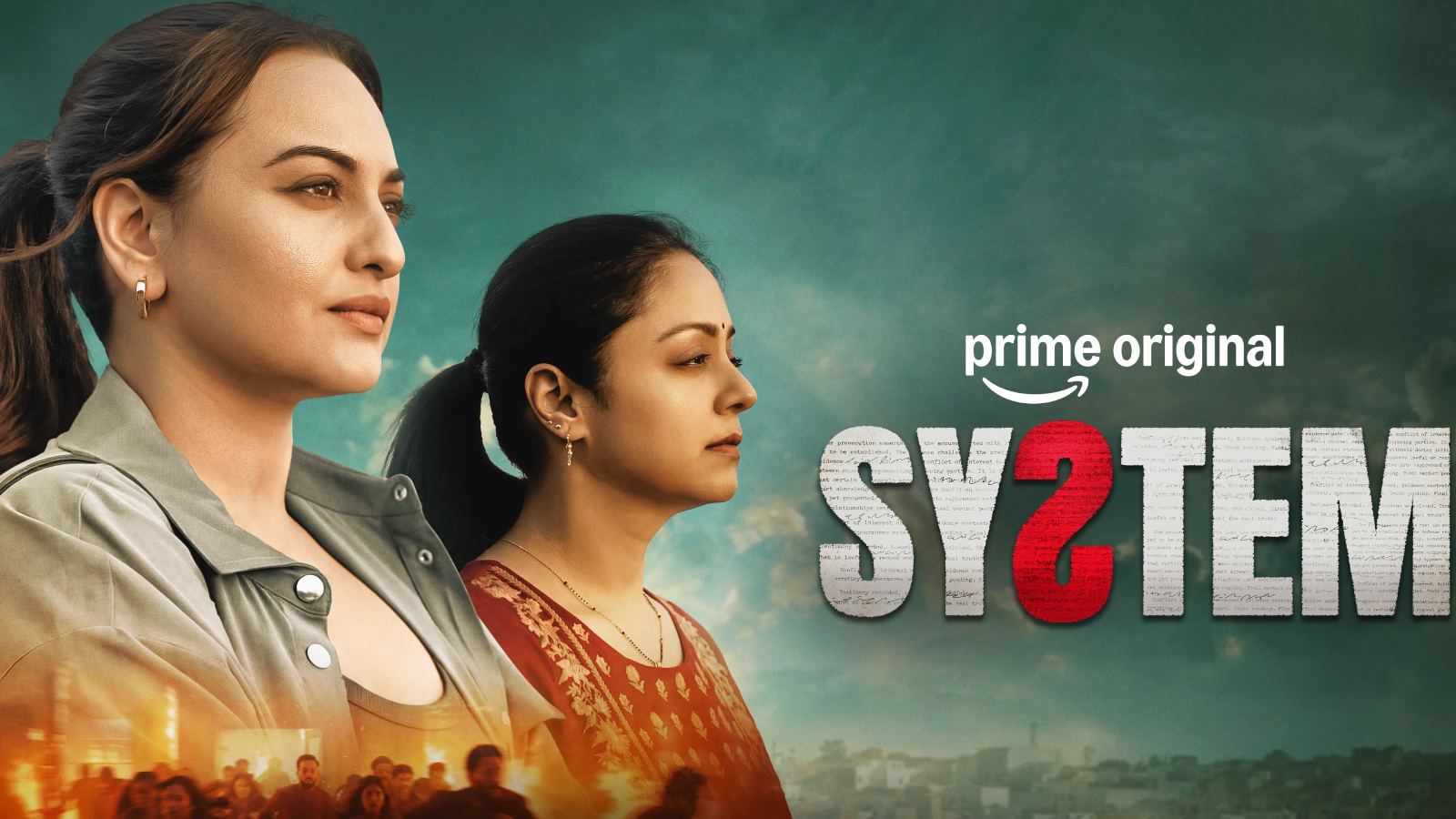
Neha Raghuvansh, a public prosecutor, is itching to be a partner at her esteemed advocate-father Ravi Raghuvansh’s law firm. Yet, Ravi believes she has to work it out the hard way, on her merit and not legacy. If she were to register 10 consecutive wins at the court, he would let Neha have her say. A court stenographer, Sarika Rawat, comes forward to help Neha, but with an agenda.
Performances
Sonakshi Sinha, as a lawyer who is finding her rhythm and voice in her career, comes up with an assured, controlled performance, balancing her heavy courtroom dialogues and poignant silences with ease. Ashutosh Gowariker is sharp as a bullet, staying firmly within the boundaries of his character, with his firm gait and body language helping his cause.
Jyotika’s toned-down portrayal is decent but lacks a strong impact. Her expressions appear one-dimensional at times (perhaps due to the character?). Veteran Vijayant Kohli, as the most obvious bad guy in the story, fits the part. Adinath Kothare, Gaurav Pandey, Preeti Agarwal and Nishant Singh do justice to their roles.
Analysis
System is a legal drama that works like an escapist fantasy for those victimised by the judiciary. How far can a victim go to settle scores? There’s poetic justice towards the end, but at what cost? The system, originally in place to protect the innocent and punish the corrupt, turns into a weapon to exact revenge.
Although the film is a straightforward revenge story unfolding within a courtroom setting, touching upon privilege and classism, writers Harman Baweja and Arun Sukumar weave several layers into a simplistic premise. As a result, it’s also a father-daughter drama, a whodunit and stories of two women fighting hard battles within a male bastion.
Neha, despite being the daughter of a famous lawyer, feels she’s being punished to rise the ladder in the same profession. Her mother is always the peace-maker in the professional/personal tussle between the ambitious daughter and the highly competitive father. Expectedly, they’re pitted against one another at one point.
At the other end of the spectrum is Sarika Rawat, a court stenographer, the bread-winner in a house with a disabled husband and a talented school-going daughter, consistently juggling odd jobs to make ends meet. Her experience at the court comes in handy for Neha to drive her career forward.
One of the film’s victories is how it makes the viewer care for its characters, their micro and macro concerns, through the minutiae of daily life. Director Ashwiny Iyer Tiwari avoids every opportunity to paint any character in black and white and makes us see the world through their eyes, with a humanist outlook.
While Neha is at odds with her father about not letting her join his firm, it turns out to be a blessing in disguise. It helps her find a voice, trust her conscience, something that her brother (who has been a papa-loyalist) eventually envies and appreciates. The father, although snobbish, is just someone who takes his profession too seriously.
The final conversation that Neha and her father share after their courtroom arguments provides a good perspective of how the case shapes her course as a lawyer and the ever-changing father-daughter dynamics. Surprisingly, for a legal drama, what happens beyond the court excites you more than the drama within the four walls.
In the backdrop where Sarika is placed, beneath the veneer of her grit and resolve to confront the injustice meted out to her family, the understanding of life at a low-income household feels slightly misplaced. It’s surprising how she is conceived as a woman appearing ready to be treated as a pound of flesh to get her work done.
System reflects a long-standing problem in Hindi cinema of obsessing with extremes in society – the rich and the poor, as if nothing exists in between. And more so, when it deals with the poor, it is always the cramped houses, tanned faces, seething with anger about the privileged. It’s high time they treated these spaces with more nuance.
As much as the characters in the film are etched out with sincerity, the writing choices are too standard and generic. While the aim may have been to reimagine classic setups-like a father and a daughter at opposite ends of a case, the class divides, nepotistic conflicts-it doesn’t subvert the tropes as well as you expect it to.
Though System doesn’t live upto its promise, it makes for decent OTT viewing. You hope it would surprise you at some point, but it makes obvious, predictable moves. Coming from a filmmaker who helmed Panga, Bareilly Ki Barfi, and Nil Battey Sannata, it’s only fair to expect a higher standard.
Music and Other Departments?
Karthik Manickavasakam’s background score doesn’t try to force an urgency into the story. It understands the film’s sombre, tense mood, unusual pacing and still creates a neat impact. A song or two remains hummable, though without a strong recall value.
Cinematographer Rangarajan Ramabadran brings alive the contrasting worlds within the story with flair, employing a colour palette dominated by blues, blacks and whites. The writers foreshadow the narrative with too many clues of the film’s trajectory, which spoils the fun to an extent. The film’s part-slick and part-slow-burn treatment creates a few inconsistencies in the narration.
Highlights?
Sonakshi, Ashutosh’s performances and the father-daughter equation
Well-etched characters detailing their lives
Straddles multiple themes within a courtroom setting
Drawbacks?
Predictable, generic writing choices in parts
Simplistic, safe ending
Drama not always punchy
Did I Enjoy It?
Works in parts
Will You Recommend It?
If you’re a legal drama enthusiast, you may give it a try.
System OTT Movie Reviewed by M9 News