BOTTOM LINE
Gangster Drama That’s All Talk, No Fire
RATING
1.75/5
Story, Screenplay, Director: KK
Cast: Dheekshith Shetty, Shashi Odela, Yukti Thareja
Music Director: Poornachandra Tejaswi
DOP: Nagesh Banell
Editor: Shravan Katikaneni
Producer: Sudhakar Cherukuri
Presented By: SLV Cinemas
Production Company: SLV Cinemas
U.S. Distributor: Prathyangira Cinemas
Related Links: Trailer
 What Is the Film About?
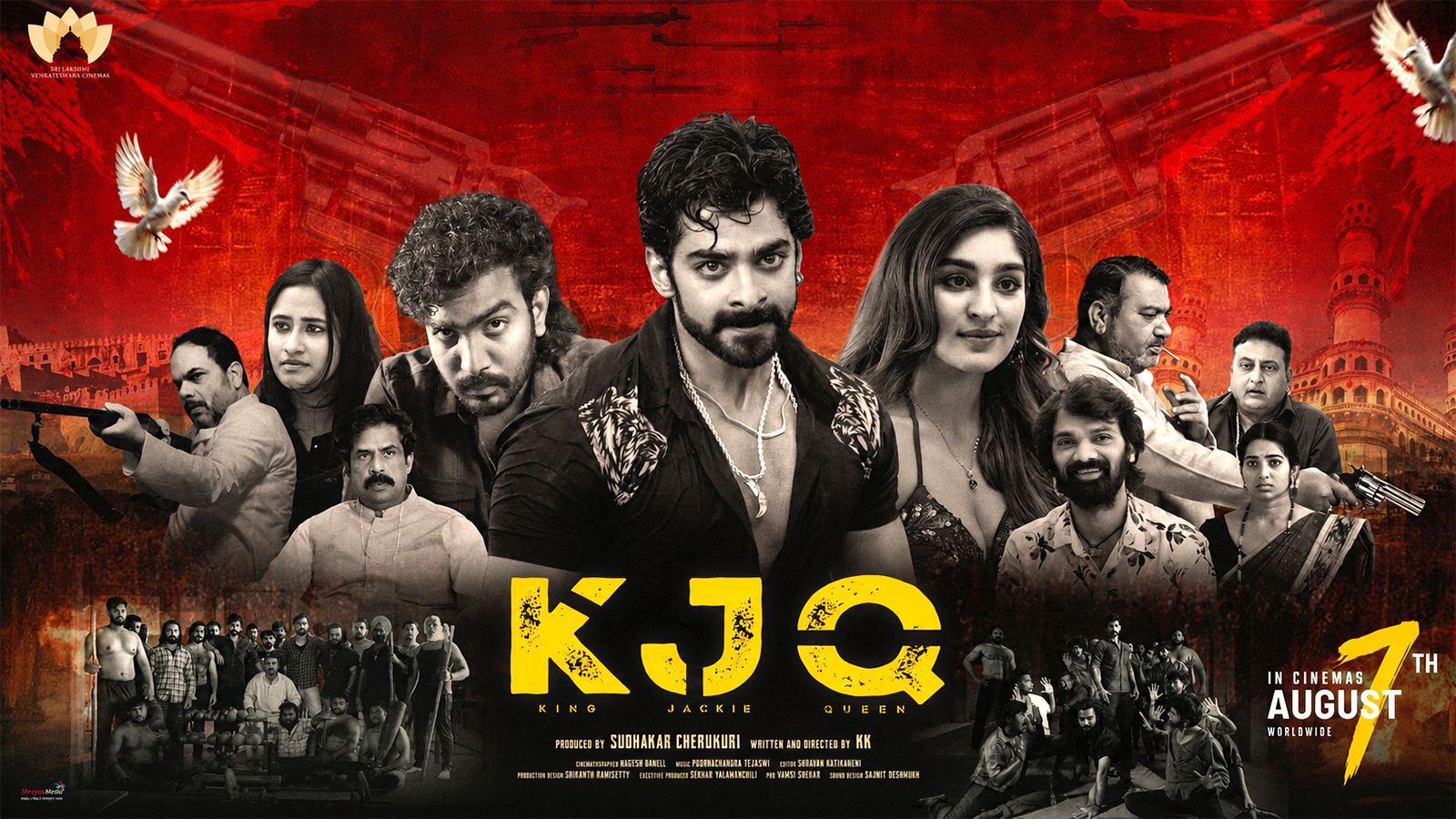
Partha and Jackie are close pals forced to choose a life of crime owing to their traumatic childhoods. While Partha aims to rule the roost as a gangster, Jackie stands by his friend’s side against all odds. Into their world enters a budding actress, Bhargavi, a fantasy Partha can’t resist and a woman Jackie is keen to protect.
Performances
Dheekshith Shetty is the only saving grace in terms of performances. He is fiery and intense as a man obsessed with power, gradually losing himself in the process. Shashi Odela struggles to emote in a role with untapped potential and appears lost in thought, much like the character he plays. Yukti Thareja is strictly okay in a role that promises much but delivers little. Others, including Guru Somasundaram, Muralidhar Goud and Surekha Vani, don’t get enough scope to make an impact.
 Analysis
After coming out of KJQ (King Jackie Queen), you’re left feeling that the best version of the film existed in the filmmaker’s head and not what eventually got made. The film plays out like a highlights package of late director Kiran Kumar’s ideas, without much context. The ambition is grand. The setup is that of a classic gangster drama with universal conflicts, but one that never quite fulfils its potential.
The plot revolves around two contrasting friends in the underworld who turn against each other over a woman, with the filmmaker using separate chapters to present each character’s perspective. Partha, Jackie and Bhargavi represent the King, Jackie and the Queen. The king wants the throne, the jackie aims to be a better human, and the queen longs for true love.
Right at the beginning, a voiceover indicates each of our paths could be drastically different depending on where we’re born, citing examples like Mother Teresa, Queen Elizabeth, SP Balasubrahmanyam and Osama Bin Laden. It is constant humiliation during childhood that pushes Partha to seek power. The need to protect his mother forces Jackie to commit a crime.
With Bhargavi, though you don’t get much of a glimpse into her childhood as you do with the men, you sense she lacks emotional security. Across all three chapters, you only get a limited understanding of their personalities. It’s like getting the icing without the actual cake. The crime backdrop is established quite mechanically, with Partha conveniently eliminating his opponents amid pompous one-liners and video game-like shootouts.
A scene depicting marital rape, where a character gives no space for his wife’s consent, is treated far too casually and is almost ignored within the context of the relationship. Partha and Jackie’s friendship, which forms the emotional foundation on which the story is meant to progress, makes no impact at all. The characters keep voicing their feelings and thoughts like rehearsed dialogues.
Jackie’s side of the story is equally weak. He is constantly lost in thought after losing a loved one in a shootout. A dialogue comparing Jackie and Partha’s personalities goes, ‘One is on the verge of turning into a monster… and the other wants to be a human again.’ The apparent tussle between the two is narrated with pomp, but fizzles out tamely. The only aspect that registers strongly is Partha’s bruised ego, due to Bhargavi.
Bhargavi’s story of being drawn into sex work and pleasing a producer to land acting opportunities is painfully old-school and regressive. The character arc of Bhanu, Partha’s wife, also lacks substance. The climax fight, borrowing inspiration from Kamal Haasan’s Nayakan, which should ideally have fired on all cylinders, is another disappointment. You don’t feel for any of the characters.
KJQ is a casually made film that takes the audience for granted and repackages outdated themes in a new bottle. What it needed was a team that approached the subject from a fresher perspective and explored the interpersonal drama with greater depth.
 Music and Other Departments?
Poornachandra Tejaswi’s music is a disappointment, except for the eclectically composed Tillana fusion. The cinematography by Nagesh Banell is ordinary. The writing squanders the potential of a few good ideas and constantly leaves you wanting more. While the chapter-based structure keeps the proceedings partially engaging, the lack of world-building and character detail leaves it feeling underdeveloped. The crisp 110-minute runtime makes little difference to the proceedings.
Highlights?
Few good ideas, even if not exploited fully
Drawbacks?
Poor writing
Weak characters and generally dull performances
Loose narration
Did I Enjoy It?
Not much. All you keep seeing are a few interesting ideas that never quite land.
Will You Recommend It?
Even if you enjoy gangster dramas, skip this one.
KJQ Movie Reviewed by Kalyan