BOTTOM LINE
Sincere, Yet Lacks Impact
PLATFORM
SonyLIV
RUNTIME
6 hours 6 minutes | 7 Episodes
What Is the Story About?
India is months away from being an independent nation, yet the anxiety surrounding the partition leaves the region uneasy. Nehru and Patel’s differences only amplify with time, owing to their contrasting paths, despite their unified goals. Gandhi remains stubborn in his call for peace, while Jinnah miraculously masks his ailing health in his fight for Pakistan.
Performances
The problems with the casting of Sidhant Gupta (as Nehru), Chirag Vohra (as Gandhi) continue to affect the show. Sidhant’s earnestness to capture Nehru’s dilemmas is appreciable, though it’s hard to tolerate Chirag’s pale caricaturing of Gandhi. The drama is largely held together by the performances of Rajendra Chawla (as Patel), Arif Zikaria (as Jinnah) and Luke McGibney (as Mountbatten). The women, Cordelia Bugeja and Ira Dubey, are left with little to do.
Analysis
There’s never been a better mirror than history to show how the world and humankind haven’t changed all these years. As much as we hold our past close to our chests, we seldom learn from it, twisting it to our convenience, pelting stones at it, or garlanding it as per our will, rather than critically engaging with it.
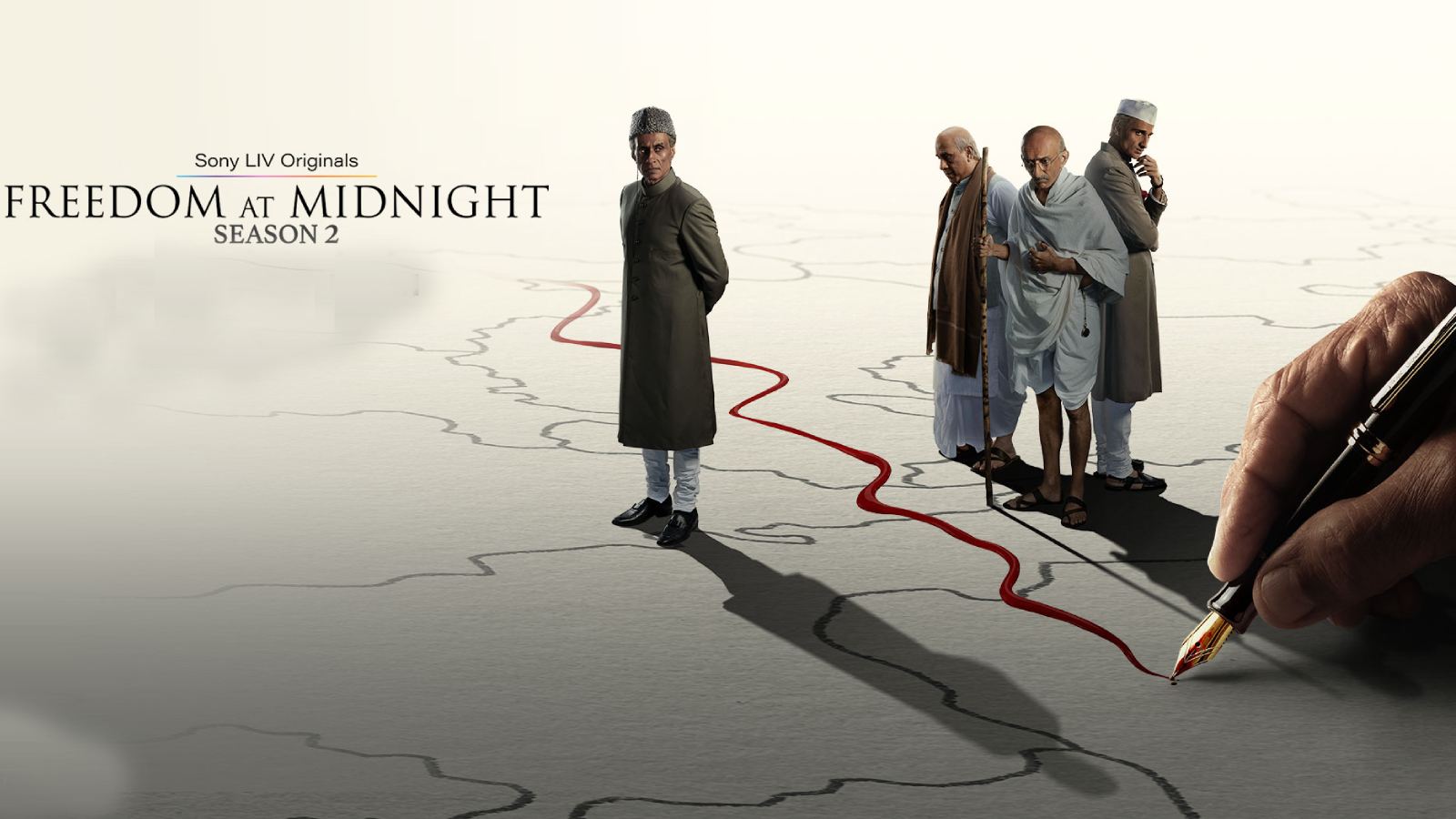
Freedom at Midnight, an adaptation of the best-selling book by Larry Collins and Dominique Lapierre, aims to bring alive the various dimensions of the freedom struggle in all its complexity, messiness, and brutality, unarguably through a western lens. Filmmaker Nikkhil Advani makes a lion-hearted effort to crystallise its essence across two seasons.
The first season was a delicate dance between the political and the personal, laying bare the ideologies that Gandhi, Nehru, Patel, and Jinnah swore by, offering a taste of pre-independence era politics and its repercussions on the common man. Freedom at Midnight 2 explores the complex emotions evoked by the concept of freedom, as the volatile situation feels like an untameable beast.
Punjab, Calcutta, and Lahore are withering apart in riots. Mountbatten struggles to maintain a balancing act among opposing viewpoints in a vulnerable hour. Although Nehru means well, his political decisions lead to catastrophic consequences, further widening the rift between him and Patel. There are continuous negotiations on the terms of the India-Pakistan split and the integration of the princely states.
There’s unhappiness among Nehru and Jinnah’s camps over the fragmentation of Punjab. The origins of the Kashmir border issues come to the fore. The label of a Mahatma feels like a heavy cross to bear for Gandhi, who reminds people that he’s human after all. Jinnah’s health continues to decline. The optimism about a new start is amiss in both India and Pakistan.
Despite its dense writing, the staging – while quickly alternating from one historical event to another – lacks strong impact. Out-of-place makeup and jarring wigs distract from the core theme, while the actors feel as though they are training for a verbose play. The execution is too conscious of the era’s epic scale and crams in too much information, leaving little room for the viewer to breathe.
While the material challenges you to absorb multiple perspectives and delves into the mindspace of its pivotal figures with sincerity, the drama never strikes a chord on a human level. It offers no space for reflection and is desperate to be an all-encompassing reference point at the cost of storytelling finesse. By the end, you simply want to be done with the history lesson.
Where the show primarily succeeds is in its ability to serve as a parallel to today’s times, in which we find newer ways to quarrel over our differences than appreciate our plurality. The choice to end the show with Gandhi’s death and how it helps Patel and Nehru bury the hatchet is particularly interesting. It tells us where India began, at a moment when it could have easily fallen apart.
Freedom at Midnight Season 2 continues the good work of the first part but lacks the dramatic grip of its predecessor. Some segments register, though the show eventually gets carried away by the density of the subject at hand. The writing feels stuffy, telling more than showing and spoon-feeding the audience to the point where they are left exhausted rather than engaged.
Music and Other Departments?
Ashutosh Phatak’s score is consistently screaming for attention. Sometimes, all you want is a bit of calm to process the verbal duels; the music denies you that pleasure. Similarly, the muted colour-grading denies the show a strong visual appeal; it’s always trying to prove a point that it’s serious about what it wants to say. While the production design and costume choices are excellent, the adaptation needed pruning. It simply doesn’t know where to stop.
Highlights?
Strong detailing, educative
Captures the complexity of the era effectively
Sincere writing
Drawbacks?
Overcooked with events – no space to reflect
Makeup, styling issues
Too verbose
Did I Enjoy It?
Worked for me in parts
Will You Recommend It?
Certainly, if you’re a history enthusiast
M9 Reviews vs Box Office: Simple Q & A Guide
Freedom at Midnight Season 2 Webseries Review by M9