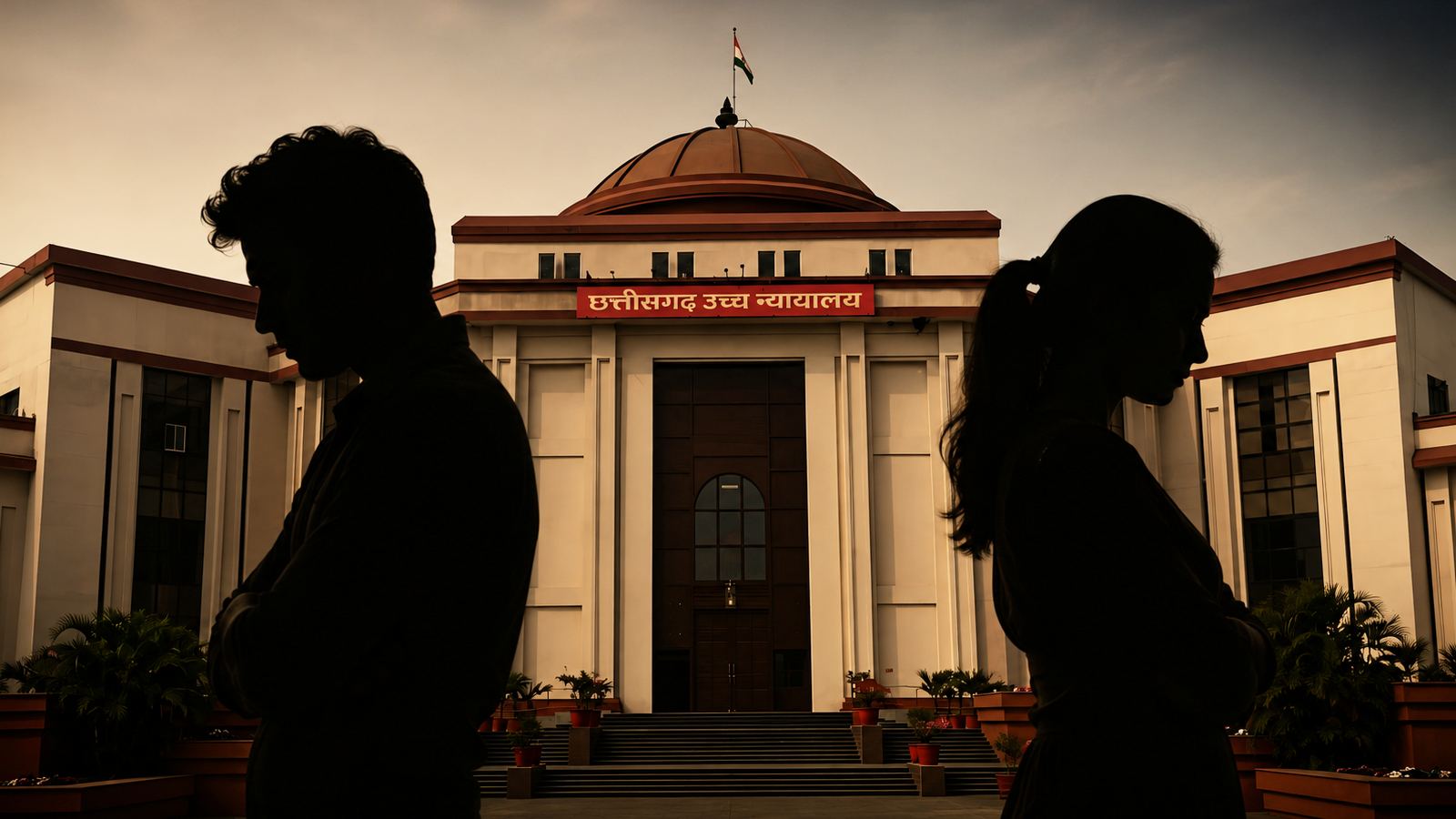
The Chhattisgarh High Court has ruled that refusing to marry a long-term live-in partner does not automatically amount to rape. The court observed that a long-term live-in relationship between two adults generally carries a presumption of consent in their physical relationship.
A bench of Justices Sanjay S Agrawal and Narendra Kumar Vyas delivered the judgment. The court said that while couples in live-in relationships may intend to marry in the future, such an intention alone does not prove that their physical relationship existed only because of a promise of marriage.
The case arose after a woman challenged the acquittal of a man accused of rape and unnatural sex. The woman, a 40-year-old Project Manager with the Bhilai Municipal Corporation, said she met the accused while pursuing an MBA at the Indian Institute of Management Raipur in 2019.
According to her, the accused promised to marry her, following which they entered into a physical relationship. The two lived together for nearly two years.
The woman alleged that after completing their MBA, the accused began avoiding conversations about marriage. She claimed he later told her that his parents opposed the marriage because she was older, a divorcee and a Christian.
She further alleged that on November 28, 2021, when she visited his residence and again requested him to marry her, he subjected her to unnatural sexual intercourse against her wishes.
A First Information Report was registered in December 2022 under Sections 376 and 377 of the Indian Penal Code. However, the trial court acquitted the accused, stating that the prosecution had failed to prove the charges beyond reasonable doubt.
The woman then challenged the acquittal before the Chhattisgarh High Court. During the hearing, the court examined several aspects of her cross-examination.
The court noted that the woman admitted she was willing to settle the dispute before the Women’s Commission for Rs 30 lakh. The accused had also handed over a cheque of Rs 15 lakh as part of the proposed settlement.
However, the payment was stopped after the settlement did not materialise. The court considered this while examining the overall evidence.
The bench also noted the woman’s statement that both had agreed to marry only with the consent of their respective families. It also considered her brother’s testimony that she had told him their physical relationship developed during a love affair.
The court further relied on the medical evidence presented in the case. The doctor who examined the woman stated that she had not complained of forced sexual intercourse or unnatural sex during the medical examination.
The doctor also found no injuries suggesting unnatural sexual intercourse. Based on the available evidence, the court found no reason to interfere with the trial court’s findings.
The High Court held that the relationship between the two adults was consensual. It observed that in a long-term live-in relationship, it can be presumed that both partners voluntarily entered the relationship with an understanding of its consequences.