BOTTOM LINE
Agatha Christie-Style Mystery Works In Parts
PLATFORM
ZEE5
RUNTIME
1Hr 39Mins.
What Is the Film About?
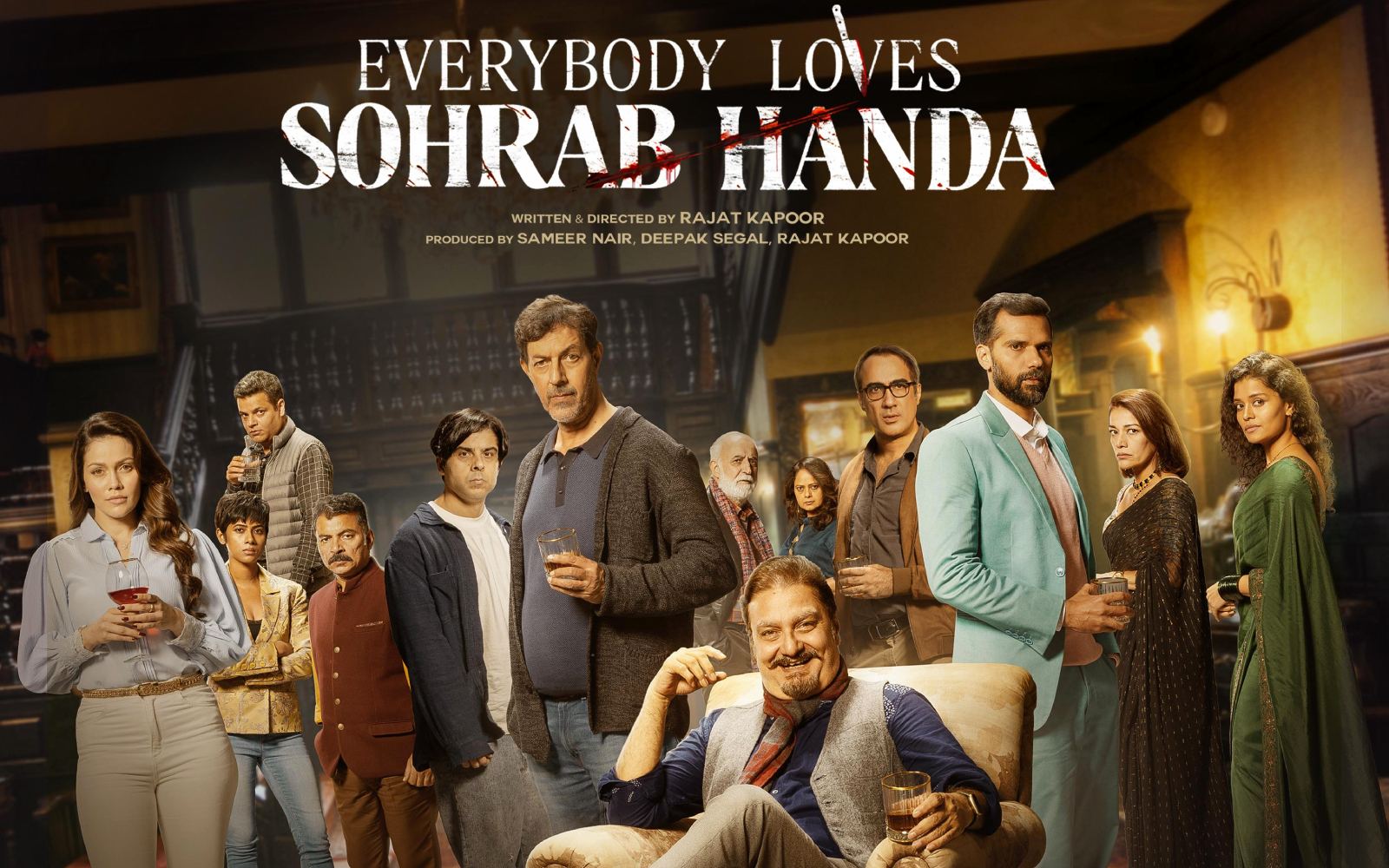
Raman and Jayanti invite friends to a resort to celebrate their tenth anniversary. The party turns nasty when a guest, Sohrab Handa, starts bullying everyone and exposing their secrets. By morning, Sohrab is found murdered. Since the house was locked, the killer must be one of the friends. Inspector Qureshi arrives to find the truth, proving that even ‘nice’ people can hide a deadly streak.
Performances
Vinay Pathak is undeniably the show-stealer, cast in the most unlikeable role of the film. Yet his dialogues and cocky behaviour keep you thinking, even if you do not empathise with him. Neil Bhoopalam, as the typical, snooty urban man, delivers what is expected of him. Ranvir Shorey fits the bill as the professor. Koel Purie and Chandrachoor Rai shine the most among others. M K Raina and Rajat Kapoor lend authority to their brief yet assured portrayals.
Analysis
Helmed by Rajat Kapoor, Everybody Loves Sohrab Handa is to urban high society what Govind Nihalani’s Party (1984) was to the theatre fraternity. The murder, occurring mid-celebration, unpacks the hypocrisies of guests who wear masks of civility to guard the darker corners of their souls. Here, the investigation is merely an excuse for their internal venom to surface.
Kapoor intentionally bridges various social dimensions through this anniversary gathering. We see a TV personality who has traded his moral code for TRPs, a philosophy professor using classical quotes to mask his own insecurities. The bully of the gang, Sohrab, who eventually gets murdered, is accompanied by his wife, brother and his father. His bitterness eventually lends a sour flavour to the celebration.
The party hosts plan the gathering with a business deal in mind involving Sohrab. As the drama unfurls across meals and games, a psychiatrist attempts to decode the group’s behaviour through their smallest gestures. The narrative isn’t only about Sohrab Handa’s toxicity, but also about the people responsible for his decay. What, after all, consumed him even before his murder?
The film’s primary strength is how it lets the core identities of its pivotal characters, over a dozen of them, come through effortlessly. Regardless of the screen time allotted to each of the parts, their essence is captured effectively sans much ambiguity. It serves as a brutal critique of the typical shallowness in socialite gatherings, where everyone claims to be friends but is caught up in their own chaos.
The director’s choice of a non-linear narrative builds tension organically, comparing the happy-go-lucky vibes of the morning to the anxious moments following the death. As with a typical Knives Out or Agatha Christie setup, everyone blames the other for the crime. Most characters have grey areas and a motive, at some level, to witness the end of Sohrab Handa.
What stays with you much after the film is Sohrab’s talk with his brother, Arun, as he stares at an old tree. He marvels at the beauty of nature in stark contrast to what humans have become. That moment, in a nutshell, defines what Sohrab was and what he later turned into. The anger against Sohrab is justified as he keeps dropping truth bombs viciously and passing crude judgments, taking everyone to the cleaners.
Everybody Loves Sohrab Handa functions better as a ‘whydunnit’ than a ‘whodunnit’. More than the act itself, what warrants your curiosity is the possible motive, so much so that they had to kill him. Death feels like the only closure that Sohrab could have received, given the misanthropist he had become. The cop only serves as a mute witness to the tense exchanges between the friends and the family.
Yet, it is not a film for everyone; it is hard to decode, digest, and absorb what it wants to communicate at times. The intentions, specifically to expose the facade beneath the supposedly urbane society, do not always translate into the execution. More than the mystery, an element of vagueness envelopes the narrative. The tension in the room loses its bite across a few intervals, and the ending feels slightly jarring, too.
Everybody Loves Sohrab Handa is undoubtedly niche in its appeal, but give it some time to grow on you and do not be quick to dismiss it.
Music and Other Departments?
Sagar Desai’s minimal use of a background score in what is essentially a conversational drama turns out to be an effective creative choice. There is no needless dramatisation or over-emphasis on reactions, which allows you to appreciate the film better. Full props to cinematographer Rafey Mahmood for keeping the frames consistently busy despite the film being set in the same location for a major portion. The costumes and apt production design bring classiness to the result.
Highlights?
Solid performances
Controlled execution without unnecessary melodrama
Impressive on the technical front
Drawbacks?
Gets too abstract/vague with whatever it tries to convey
Unfolds like a stage play, lacks a cinematic quality
Half-satisfying climax (it feels like a sudden, impulsive twist)
Did I Enjoy It?
Works in parts
Will You Recommend It?
If you like slow-burn social satires packaged like a murder mystery, give it a try
Everybody Loves Sohrab Handa Reviewed by M9 News